Elements of Spacecraft Design

In a solid motor the oxidizer and fuel are stored in the combustion chamber as a mechanical mixture in solid form. When the propellants are ignited, they burn in place. Solid rocket systems are used extensively in situations where 1) the total impulse requirement is known accurately in advance and 2) restart is not required. Boosters for Titan IV and the Space Shuttle are good examples of such a situation. Spacecraft examples are the kick stage for a geosynchronous orbiter and the orbit insertion motor for a planetary orbiter. Solid motors are used in applications requiring impulse as small as 196,000 N-s (Explorer I motor) up to the 1.45 billion N-s (one shuttle booster motor). Sizes range from 15 cm diam to 6.6 m.
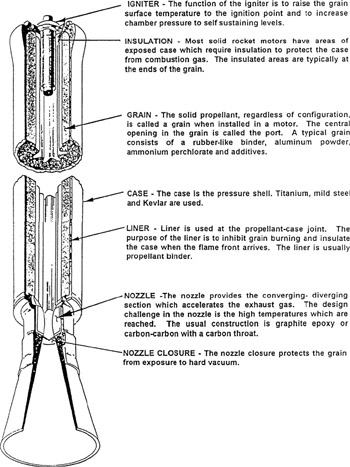
The elements of a solid rocket motor are shown in Fig. 4.46 and discussed in subsequent sections of this chapter.
Solid rockets are over 700 years old, having been used by the Chinese in 1232. The basis of Chinese rockets was ordinary black powder, the gun powder of muzzle loaders. Smokeless powder was invented by Alfred Nobel in 1879, but it was not used as solid rocket fuel until Goddard tried it in 1918. He concluded that liquid propellants would be the best development path for space work, and his conclusion held true for 50 years. Double-base propellant, which is the interesting combination of nitrocellulose dissolved in nitroglycerin, was used for...