Elements of Spacecraft Design

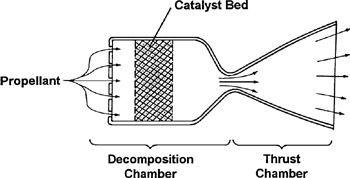
A monopropellant system generates hot, high-velocity gas by triggering decomposition of a single chemical a monopropellant. The concept is shown in Fig. 4.17.
The monopropellant is injected into a catalyst bed, where it decomposes; the resulting hot gases are expelled through a converging/diverging nozzle generating thrust. A monopropellant must be a slightly unstable chemical, which will decompose exothermally to produce a hot gas. There are a number of chemicals, which will do this. Table 4.6 lists some of these.
| Chemical | Density | Flame temperature, K | I sp, s | Sensitivity |
|---|---|---|---|---|
| Methyl nitrate | 1.21 | 3716 | 259 | Yes |
| Nitromethane | 1.13 | 2479 | 244 | Yes |
| Nitroglycerine | 1.60 | 3309 | 244 | Yes |
| Ethyl nitrate | 1.10 | 1944 | 224 | Yes |
| Hydrazine | 1.01 | 1394 | 230 | No |
| Tetronitromethane | 1.65 | 2170 | 180 | Yes |
| Hydrogen peroxide | 1.45 | 1277 | 165 | No |
| Ethylene oxide | 0.87 | 1233 | 189 | No |
| n-Propyl nitrate | 1.06 | 1693 | 201 | Yes |
| [a]Courtesy of McGraw Hill; [3], pp. 20 41. |
There are a number of practical considerations, notably stability, that thin the list in Table 4.6. Only three monopropellants have ever been used on flight vehicles: hydrazine, hydrogen peroxide, and n-propyl nitrate. Shock sensitivity eliminated n-propyl nitrate after limited use for jet engine starters. Hydrogen peroxide saw considerable service as a monopropellant in the 1950s and 1960s (starting with the V-2). The persistent problem with hydrogen peroxide is slow decomposition during storage. The decomposition products cause a continuous increase in pressure in the storage vessel and water dilution of...