Elements of Spacecraft Design

There are three major activities involved in setting the requirements for a spacecraft propulsion system. The first decision, and the one which has the most far reaching impact, is the selection of propulsion system type. This choice is described in Section 4.3.1. Secondarily, the translational and rotational thrust levels and propellant allocations are determined. These activities are discussed in Sections 4.3.2 and 4.3.3.
Current propulsion technology provides five basically different, widely used, propulsion choices: cold-gas systems, solid motor systems, monopropellant systems, bipropellant systems, and dual-mode systems; each has its niche in spacecraft design. The selection of propulsion system type has substantial impact on the total spacecraft and is a key selection in early design.
There are two other system types, which are feasible and are beginning to be used. These are the following: ion propulsion, which received an exhaustive flight demonstration on Deep Space 1, and Hall effect thrusters, which were extensively used by the former USSR and are now being used on U.S. spacecraft. Both of these new systems are for low thrust applications.
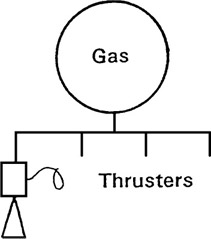
Almost all of the spacecraft of the 1960s used this system (see Fig. 4.4). It is the simplest choice and the least expensive. Cold-gas systems can provide multiple restarts and pulsing. The major disadvantage of the system is low specific impulse (about 40 s) and low thrust levels (less than a newton) with resultant high weight for all but low total impulse missions.