Elements of Spacecraft Design

Chapter 9: Telecommunication

9.1 Fundamentals

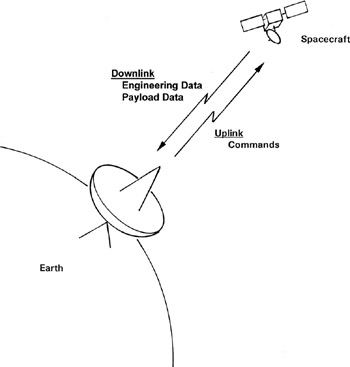
Communication with a spacecraft takes place over two types of links as shown in Fig. 9.1. An uplink carries commands from a ground station to the spacecraft. Commands are specially formatted digital streams that tell the spacecraft what to do. They can be immediately executed or, more frequently, stored for execution at a specified time. Usually a command upload contains instructions for a whole timed sequence of events. For example, a normal upload for Magellan provided the spacecraft with four days of instructions, enough for 30 orbits and 120 maneuvers. A new upload was sent up on the third day.


Figure 9.1: Communication links.

A downlink carries payload (science) data, the data the spacecraft was sent to get, and the engineering or telemetry data, which show the status of the spacecraft subsystems. The engineering and payload data can be in the same or separate data streams. The payload data are usually a much higher data rate than the engineering or command links.

When a ground station is only receiving the downlink data from a spacecraft, the communication is called one-way. When the ground system is receiving downlink data and the spacecraft is receiving uplink data, the link is called two-way.

The communication links are also used for tracking the spacecraft by measuring the angular position of the downlink signal, by Doppler measurements and by ranging, or two-way Doppler.

In the first section of this chapter, the basic physics of radio communication will be discussed.

UNLIMITED FREE
ACCESS
TO THE WORLD'S BEST IDEAS

SUBMIT
Already a GlobalSpec user? Log in.

This is embarrasing...

An error occurred while processing the form. Please try again in a few minutes.

Customize Your GlobalSpec Experience

Category: Telemetry Receivers and Telemetry Transmitters
Finish!
Privacy Policy

This is embarrasing...

An error occurred while processing the form. Please try again in a few minutes.