Local Energy: Distributed Generation of Heat and Power
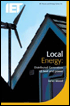
1.3: Coordinating the Supply

1.3 Coordinating the Supply

In 1926 the new Electricity Act not only provided for existing undertakings to maintain control of distribution, but also provided for the coordination of new power-station planning and the control of power stations. It established a public body, the Central Electricity Board, which had a remit to standardize electricity supply across the country. It also had powers to control power stations' operations and to establish a 'grid' of high-voltage transmission lines.

The 'grid' was required because small domestic power generation was steadily being replaced by larger, more efficient power stations that served hundreds or thousands of users. This allowed for economies of scale, but transmitting electricity along electric wires can mean that much of the energy is dissipated depending on the type of wire, energy can be lost as heat, for example; this is the principle by which the traditional incandescent light operates.

However, the rate at which energy is dissipated varies depending on the voltage and current measured in the wire. A high current, when lots of charge is moving in the wire, has a much greater heating effect than a high voltage. The total energy is a product of the voltage and the current. Another result of this relationship is that, if the energy remains the same, a higher voltage must result in a lower current, and vice versa. At lower current, less energy is dissipated and there is potential to transport much more power.

Power designers took advantage of this relationship in...

UNLIMITED FREE
ACCESS
TO THE WORLD'S BEST IDEAS

SUBMIT
Already a GlobalSpec user? Log in.

This is embarrasing...

An error occurred while processing the form. Please try again in a few minutes.

Customize Your GlobalSpec Experience

Category: Power Transformers
Finish!
Privacy Policy

This is embarrasing...

An error occurred while processing the form. Please try again in a few minutes.