Local Energy: Distributed Generation of Heat and Power
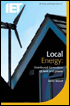
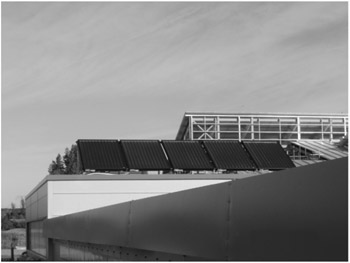
Solar power can be used both for water heating, as at this project, and to produce electricity directly.
Solar power sometimes causes confusion because there are two ways of using the sun's energy directly. If what you want is heat for warm rooms or hot water you need solar thermal as described in Chapter 3. But if you want to generate electricity you need photovoltaics PV for short.
PV panels turn sunlight directly into electricity, thanks to a property of their major component silicon, the most abundant element on earth.
Metals conduct electricity if the outer electrons on each atom are attached to the atom so lightly that they can drift away under the influence of a magnetic field. This electron drift is the electric current. Silicon atoms hold on to the electrons that surround them, but some are held less tightly than others and the right-sized hit of energy can knock them loose. Sunlight provides that energy hit, so when light shines on it some electrons are freed.
Once the electrons are freed they can flow around a circuit and that is an electric current. Note that it is the light, not the heat, from the sun that enables the electricity to flow, so photovoltaics are just as effective in cold countries as in hot provided there are long hours of sunlight.
The principle is fairly simple, but turning a few stray...