Local Energy: Distributed Generation of Heat and Power
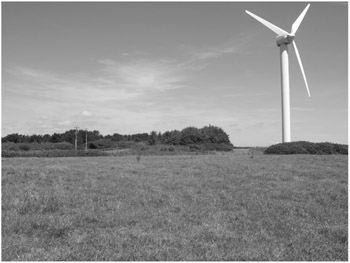
Wind turbines are becoming a familiar sight, both as large wind farms and singly, as here.
So far, wind has been the most visible form of embedded generation, as small-scale wind farms have been developed across the UK in the last five years. But wind power has many other guises that make it fit a variety of embedded generation needs, from single houses to large industrial users.
The wind farms generally being installed share a three-bladed design that has become the standard offering from major suppliers. Thousands of turbines of this style have been installed worldwide, and it has undergone many refinements and been scaled up to as large as 5 MW. The main components are as follows:
Tower. Made of cylindrical steel sections or open steel lattice, the tower can be from 25 to 75 m high. In most cases the wind conditions improve with tower height. At the top, a 'yaw' mechanism turns the tower head, along with the rotor and nacelle, so it faces the wind.
Rotor. There are three rotor blades, or two or one most often three made of fibreglass-reinforced polyester or wood epoxy. New designs are increasingly using blades reinforced with carbon fibre. The blades rotate around a horizontal hub that is connected to the electrical equipment in the nacelle (see below). The amount of energy produced by the turbine depends on the length of the blade and the area it 'sweeps' as it turns. Blades...