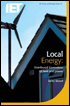
Local Energy: Distributed Generation of Heat and Power
In April 1948 the entire industry in Great Britain (except the North of Scotland HydroElectric Board, already a public board) was nationalized when the assets of 200 companies, 369 local authority undertakings and the Central Electricity Generating Board (CEGB) were brought together under the British Electricity Authority (BEA) which was known as the Central Electricity Authority (CEA) after 1954 and 14 area distribution boards.
At this time work started on building the 275 kV high-voltage grid (known as the supergrid) that operates today.
The area distribution boards accepted bulk supply from the supergrid and stepped it down to provide power to domestic properties. The power stations and transmission network were run by a central authority within the BEA.
In January 1958, following examination of the industry by the Herbert Committee and legislation, the CEA was replaced by an Electricity Council, whose function was to act as a central policy-making body for the whole of England and Wales; and a Central Electricity Generating Board, which was to be responsible for generation and main transmission in England and Wales, owning such assets as the power stations and the grid.
The CEGB inherited 262 power stations with a capacity of 24.34 GW, and annual sales of 40.3 TWh and it split the country into five operating regions.
Output increased rapidly in the 1960s and was catered for by a huge programme of power-station and transmission-line construction. By 1971 the CEGB owned 187 power stations...