Introduction to Aircraft Flight Mechanics: Performance, Static Stability, Dynamic Stability, and Classical Feedback Control

The six aircraft equations of motion developed in Chapter 4 [see Eqs. (4.70) and (4.71)] are nonlinear differential equations. They can be solved with a variety of numerical integration techniques to obtain time histories of motion variables, but it is nearly impossible to obtain closed solutions (equations for each variable). Because valuable insight can be obtained from closed solutions regarding the dynamic response of the aircraft, this chapter will use the small perturbation approach to linearize the equations of motion and facilitate the definition of closed solutions. In addition, the dynamic derivatives associated with definition of applied forces and moments on the aircraft will be discussed.
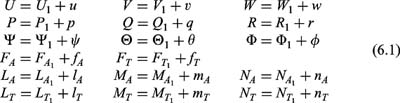
Linearization of the aircraft equations of motion begins with consideration of perturbed flight. Perturbed flight is defined relative to a steady-state (trimmed) flight condition using a combination of steady-state and perturbed variables for aircraft motion parameters and for forces and moments. Simply stated, each motion variable, Euler angle, force, and moment in the equations of motion (EOM) are redefined as the summation of a steady-state value (designated with the subscript "1") and a perturbed value (designated with lower case symbols) as summarized in Eq. (6.1).
| (6.1) | |
For example, if an aircraft has a steady-state trimmed value for U of 400 ft/s and then encounters turbulence which increases U to 402 ft/s, U at that instant would be
The "perturbed" x-axis velocity, u, would be 2 ft/s in this case. The assumption of small perturbations