This chapter will discuss special topics that amplify and add depth to the material covered in Chapters 7 9. This material primarily focuses on additional analysis techniques for feedback control systems and various types of aircraft flight control systems.
10.1 System Type and Steady-State Error
When analyzing a unity feedback system such as the one shown in Fig. 10.1, one can deduce much about the system from the number of "free integrators" in the denominator of the forward-path transfer function [ G(s)]. The number of free integrators, or free s terms, in the denominator of G(s) determines the system type.
 Figure 10.1: Unity feedback system.
 G(s) can be expressed in general terms as shown in Eq. (10.1). The value of n in the free s term defines the system type, where n = 0, 1, 2,
| (10.1) | 
|
The system type has a direct impact on the steady-state error of a system. Consider the following development for analyzing the error signal E(s) in Fig. 10.1.
where R(s) is the input and C(s) is the output. Next, relate the output to the error signal.
Substituting C(s) into the previous equation yields
Simplifying,
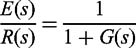
Finally, the transfer function for the error signal to the input becomes
Multiplying both sides by the input yields an expression for the error signal, as shown in Eq. (10.2).
| (10.2) | 
|
Evaluating the steady-state error involves use of the final value theorem, presented in Sec. 7.3.1.6. When applied to...


 TABLE OF CONTENTS