Introduction to Aircraft Flight Mechanics: Performance, Static Stability, Dynamic Stability, and Classical Feedback Control
7.6: Experimental Determination of Second-Order Parameters

7.6 Experimental Determination of Second-Order Parameters

For second-order oscillatory responses, several methods are available to experimentally determine key dynamic stability parameters such as damping ratio and natural frequency. Two such methods will be discussed, both of which require a time history of a key aircraft motion parameter for that mode. The time history is normally obtained in flight test by trimming the aircraft and then exciting the mode with a control doublet (a cyclic control input that perturbs the aircraft on both sides of the trim condition). The time history needed begins immediately after the doublet stops and is often referred to as the free response or transient response. For example, for the short period mode, the aircraft would be trimmed and a flight test data acquisition system would be activated to record a time history of angle of attack and/or pitch rate. The pilot would input a doublet (a quick pitch stick input: forward aft neutral) and the time history needed would begin when the stick is returned to the neutral or trimmed position.

7.6.1 Log Decrement Method

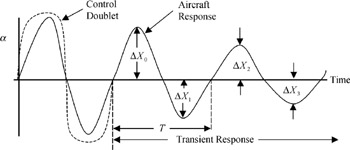
If the transient response has three or more overshoots, the log decrement method (also called the subsidence ratio or the transient peak ratio method) can be used. The value of each peak deviation from the trim condition ( ? X 0, ? X 1, ? X 2, etc.) is measured as shown in Fig. 7.29.


Figure 7.29: Log decrement method relationships.

Next, the transient peak ratios,...

UNLIMITED FREE
ACCESS
TO THE WORLD'S BEST IDEAS

SUBMIT
Already a GlobalSpec user? Log in.

This is embarrasing...

An error occurred while processing the form. Please try again in a few minutes.

Customize Your GlobalSpec Experience

Category: Logarithmic Amplifier Chips
Finish!
Privacy Policy

This is embarrasing...

An error occurred while processing the form. Please try again in a few minutes.