Introduction to Aircraft Flight Mechanics: Performance, Static Stability, Dynamic Stability, and Classical Feedback Control
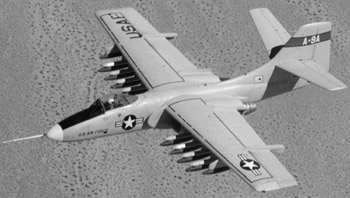
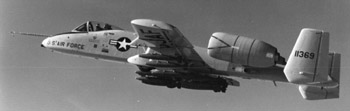
The Air Force conducted a competitive flight evaluation of two prototype close air support aircraft designs in 1972. The overall program was named the "A-X" Competitive Flyoff and the two competing aircraft were the Northrop A-9A and the Fairchild Republic A-10A. 3,4 Figures 7.33 and 7.34 present pictures of these prototype aircraft, which had significantly different design approaches to satisfy the same mission requirements.
The A-10 was declared the winner in 1973 and went on to full-scale production of 733 aircraft. It also established its reputation for lethality, responsivness, and survivability during the cold war years of the late 1970s through 1980s, and as a key aircraft in the destruction of tanks, artillery, ground vehicles, and missile sites during the Gulf War.
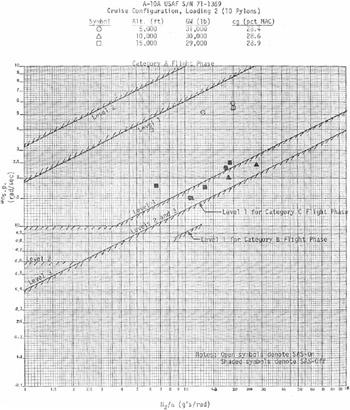
During the A-X Competitive Flyoff, the flying qualities of both aircraft were evaluated using techniques presented in this chapter. To evaluate the dynamic longitudinal stability of the short period mode, elevator doublets were performed at selected airspeed and altitude combinations to determine damping ratio and natural frequency characteristics. Figure 7.35 presents a MIL-F- 8785C short period natural frequency compliancy plot for the A-10A.
Notice that the open symbols are for evaluations with the stability augmentation system (SAS) on and the darkened symbols are with the SAS off. The SAS is a system that enhances dynamic stability characteristics and will be discussed...