This appendix will present a brief review of Cramer's rule for solving systems of simultaneous equations, such as those encountered with the aircraft equations of motion. Most engineering mathematics textbooks provide a more detailed coverage of this subject.
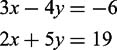
Consider the following set of simultaneous equations:
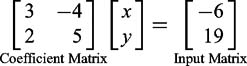
To use Cramer's rule to solve these equations for x and y, we first recast the equations in matrix format.
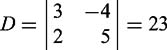
We next find the determinant of the coefficient matrix
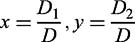
The values of x and y can then be found using
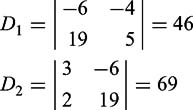
where the determinants D 1 and D 2 are obtained from the coefficient matrix with one of the appropriate columns replaced with the input matrix column as illustrated:
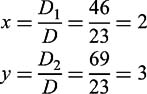
The solution then becomes
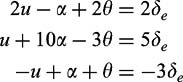
The same approach is applicable for higher-order sets of simultaneous equations. In the case of developing transfer functions for the longitudinal and lateral directional equations of motion, Cramer's rule is applied for the case of three equations and three unknowns. A simplified example of this is presented
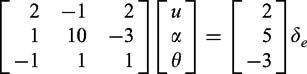
Recasting in matrix form
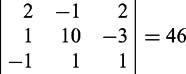
and finding the determinant of the coefficient matrix
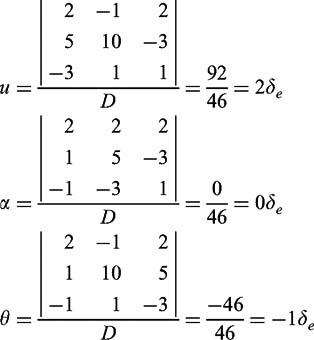
The solution then becomes
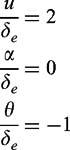
or, in transfer function form
Copyright American Institute of Aeronautics and Astronautics, Inc. 2003 under license agreement with Books24x7

 TABLE OF CONTENTS