Timing for Animation
Offers invaluable help to those who are learning the basis of animation technique.
 TABLE OF CONTENTS
 A smooth visual flow is the major objective in any film, especially if it is an animated one. Good continuity depends on co-ordinating the action of the character, choreography, scene changes and camera movement. All these different aspects cannot be considered in isolation. They must work together to put across a story point. Furthermore the right emphasis on such planning, including the behaviour of the character, must also be realised.
The storyboard should serve as a blueprint for any film project and as the first visual impression of the film. It is at this stage that the major decisions are taken as far as the film's content is concerned. It is generally accepted that no production should proceed until a satisfactory storyboard is achieved and most of the creative and technical problems which may arise during the film's production have been considered.
There is no strict rule as to how many sketches are required for a film. It depends on the type, character and content of the project. A rough guideline is approximately 100 storyboard sketches for each minute of film. If, however, a film is technically complex, the number of sketches could double. For a TV commercial, more sketches are produced as a rule because there are usually more scene changes and more action than in longer films.
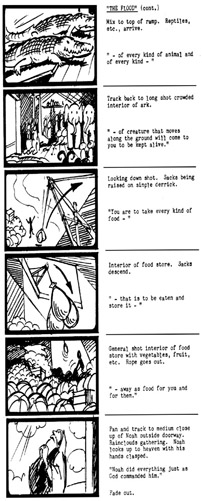
From The Story of the Bible by Halas and Batchelor. The storyboard drawings themselves are quickly done and easily replaceable, but contain all the essentials of the movement...