Timing for Animation
Offers invaluable help to those who are learning the basis of animation technique.
 TABLE OF CONTENTS
 If an object is thrown vertically upwards, its speed gradually diminishes to zero (Fig. A). It then starts to accelerate downwards again. The height to which it rises depends on the speed at which it is thrown but the rate of deceleration is the exact opposite of the acceleration as worked out on page 37. In fact the same scale can be used for both acceleration and deceleration.

A The speed of a ball, rising vertically under the influence of gravity, gradually diminishes to zero. The same spacing of drawings can be used for its acceleration as it falls back to earth.
If a ball is thrown upwards at an angle, then its movement has two components, vertical and horizontal. Vertical speed diminishes to zero and increases again as it falls, whilst at the same time its forward movement remains fairly constant. This means the ball moves along a parabola (Fig. B).

B If the ball is thrown upwards at an angle, it travels in a parabola.
If a rubber ball is thrown down on a hard smooth surface, it moves with a series of bounces. The curve between one bounce and the next is again a parabola. The parabolas diminish in height each time as some energy is lost by the ball on each bounce (Fig. C).
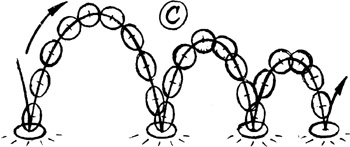
C A rubber ball bouncing on a hard surface proceeds in a series of diminishing parabolas, as energy is lost on each bounce.
If...