Timing for Animation
Offers invaluable help to those who are learning the basis of animation technique.
 TABLE OF CONTENTS
 The basis of timing in animation is the fixed projection speed of 24 frames per second (fps) for film and video. While other projection speeds have been used in the past the standard projection rate for film of all formats 16mm, 35mm and 70mm remains 24 fps. On television and video this becomes 25 frames per second (PAL) or 30 fps (NTSC), but the difference is usually imperceptible.
The thing to remember is that if an action on the screen takes one second it covers 24 frames of film, and if it takes half a second it covers 12 frames and so on.
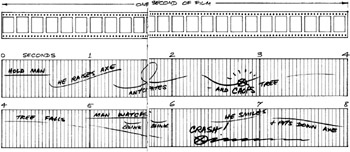
24 frames of film go through the projector every second (25 on television). This fixed number of frames provides the basis on which all actions are planned and timed by the director.
For single frame animation, where one drawing is done for each frame, a second of action needs 24 drawings. If the same action is animated on double frames, where each drawing is photographed twice in succession, 12 drawings are necessary out the number of frames and hence the speed of the action would be the same in both cases.
Whatever the mood or pace of the action that appears on the screen, whether it be a frantic chase or a romantic love scene, all timing calculations must be based on the fact that the projector continues to hammer away at its constant projection rate. That is 24 fps for film...