Timing for Animation
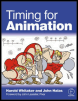
Offers invaluable help to those who are learning the basis of animation technique.
 TABLE OF CONTENTS
 The basic question which an animator is continually asking himself is: What will happen to this object when a force acts upon it? . And the success of his animation largely depends on how well he answers this question.
All objects in nature have their own weight, construction and degree of flexibility, and therefore each behaves in its own individual way when a force acts upon it. This behaviour, a combination of position and timing, is the basis of animation. Animation consists of drawings, which have neither weight nor do they have any forces acting on them. In certain types of limited or abstract animation, the drawings can be treated as moving patterns. However, in order to give meaning to movement, the animator must consider Newton's laws of motion which contain all the information necessary to move characters and objects around. There are many aspects of his theories which are important in this book. However, it is not necessary to know the laws of motion in their verbal form, but in the way which is familiar to everyone, that is by watching things move. For instance, everyone knows that things do not start moving suddenly from rest even a cannonball has to accelerate to its maximum speed when fired. Nor do things suddenly stop dead a car hitting a wall of concrete carries on moving after the first impact, during which time it folds itself rapidly up into a wreck.
It is not the exaggeration of the weight...