Timing for Animation
Offers invaluable help to those who are learning the basis of animation technique.
 TABLE OF CONTENTS
 When the director has completed the bar sheets for a film, the information is split up scene by scene ready for distribution to the animators.
The timing is transferred to printed exposure charts (known as dope sheets in the USA). Some studios use charts with units of 4 seconds (96 frames) on each sheet. Others who primarily work in television where the speed of projection is 25 frames per second, use sheets in 100 frame units which provide 4 seconds of running time for television.
Animation timing is usually indicated by the director in the left column of exposure charts, so that the animator can work out the number of drawings required to complete each action in the other columns. This information is useful to all members of an animation unit; the animators, their assistants and the cameraman. Alongside the production of animation, the exposure charts are filled in according to the levels of celluloids to be photographed and eventually serve as guides for photography.
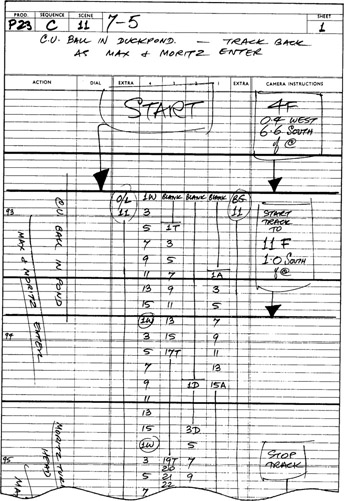
Part of a completed exposure chart for an individual scene. Each horizontal division represents one frame of film. The director's timing is in the lefthand column and the camera instructions are on the right. The animator has written the numbers of his drawings in the middle six columns.