Timing for Animation
Offers invaluable help to those who are learning the basis of animation technique.
 TABLE OF CONTENTS
 There is a train of cause and effect which runs through an object when it is acted upon by a force. This is the result of the transmission of the force through a more or less flexible medium (ie caricatured matter). This is one aspect of good movement in animation.
An animator must understand the mechanics of the natural movement of an object and then keep this knowledge in the back of his mind whilst he concentrates on the real business of animation. This is the creation of mood and conveying the right feeling by the way an action is done.
Examples of cause and effect:
A rope wrapped around anything and pulled tight has the tendency shown. How far the reaction goes depends on:
the strength of the forces pulling the rope.
the flexibility or rigidity of the object being squeezed. Exaggerate the tendency.
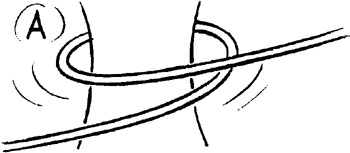
A A rope wrapped round something.
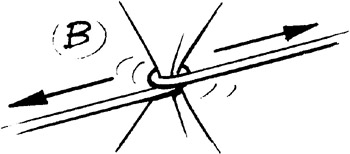
B The ends of the rope are pulled tight.
On the seesaw, the end of the plank with the smaller stone tends to stay where it is to begin with because of its inertia, so bending plank D. A moment later it starts to accelerate and the plank springs back with the opposite curvature causing the stone to whizz out of the screen, E.
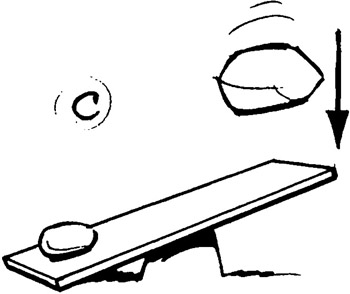
C A stone on one end of a seesaw.
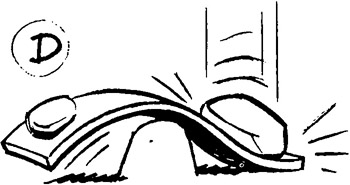
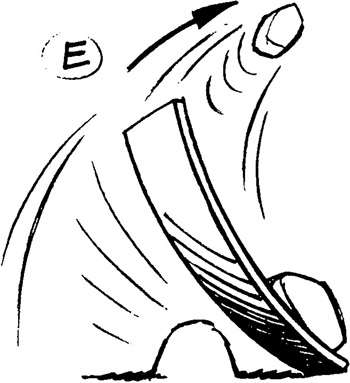
D and E A bigger stone drops onto the other end.