ASP .NET Web Developer's Guide

Learn to develop Web applications for Microsoft's .NET platform using ASP.NET.
 TABLE OF CONTENTS
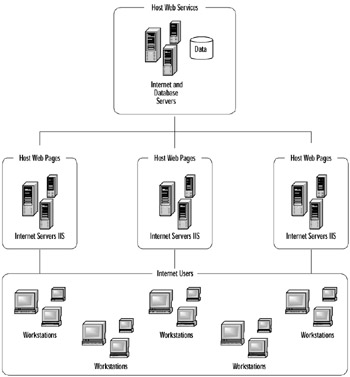
 Web Services provide a new level of interaction to ASP.NET applications. The ability to access and use a remote Web service to perform a function within an ASP.NET Web application enables programmers to quickly deliver a more sophisticated app in less time. The programmer no longer has to create and maintain all functions of the application. Reusability is also greatly enhanced by creating multiple Web services that perform functions in multiple applications, thus freeing up time and resources to work on other aspects of specific projects. See Figure 10.1, which shows a graphical representation of this process.
Web Services function primarily through XML in order to pass information back and forth through the Hypertext Transfer Protocol (HTTP). Web Services are a vital part of what the .NET Framework offers to programmers. XML-based data transfer is realized, enabling primitive types, enumerations, and even classes to be passed through Web Services to the application performing the request. This brings a whole new level of reusability to an application. XML is the backbone from which the whole Framework is built. The user interface (UI) can be created by applying Extensible Stylesheet Language Transformations (XSLTs) or by loading the data into DataSets and binding to Web Controls. Having XML as the intermediary enables new avenues of client design.
Web Services are objects and methods that can be invoked from any client over HTTP. Web Services are built on the Simple Object...