Configuring Cisco AVVID
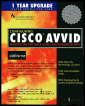
Introduces Cisco s converged media services technology, and the hardware and software required to make it work.
 TABLE OF CONTENTS
 IP-enabled phones provide unified telecommunications and data systems that can easily be installed, managed, and expanded by IT personnel. Unlike traditional phones, IP-enabled phones can be managed better according to routing protocols, available bandwidth, and inherent network fault tolerance. Aside from usage inside the office, using IP-enabled phones to extend the office with true call forward (by IP address) is another major factor in why you might want to choose an AVVID telephony solution. It enables a company to fully integrate field home users to their office without incurring additional expenses.
IP phone sets vary greatly between manufacturers. Cisco does produce its own, but many more manufacturers are in the process of creating compatible units. These units offer a number of promises that vary according to model. For instance, low-end models offer phone support with a built-in 10 Mbps hub to link a PC or other Ethernet device. Higher-end models support 100 Mbps perhaps via switch and may include a camera or optional USB interface.
However, without looking too far into the eventual technology, phones, regardless of their features, are now classified into two categories those that use inline power and those that rely on an external source. Of these phones, Cisco supports a first-generation series by use of an external power source, while its second-generation phone can use either an inline or an external power source.
Cisco s first-generation IP telephones have been discontinued; however, they can still be found in the market...