Configuring Cisco AVVID
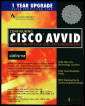
Introduces Cisco s converged media services technology, and the hardware and software required to make it work.
 TABLE OF CONTENTS
 In early Ethernet networks, hubs were used to migrate users from coax cable to a more reliable twisted-pair media. Hubs were convenient and easy to configure but suffered great performance issues with collisions occurring over the hub s shared medium. As such, bridges and routers were used to break up broadcast and collision domains. Because a router does not forward broadcast, microsegmenting was simple but problematic with protocols, which did not support hierarchical protocols. An aftereffect was the configuration of Cisco routers as bridges. Today, these bridges still exist but in a multiport format known as a switch. Unlike hubs, switches do not have collision problems; however, they tend to suffer great performance loss with regard to large numbers of broadcasts. In an innovative move, Cisco introduced the first form of VLANs and integrated them into their routing.
VLANs define a broadcast domain for which an administrator may associate ports in one or more switches as members. As a Layer 2 topology, switches are unable to view IP information, and therefore a router is required to communicate between VLANs. Frequently a router is integrated within the switch to produce Layer 3 switching. When operating between switches, designating VLAN trunks, which carry traffic of multiple VLANS, preserves VLAN information. Depending on the destination that a trunk leads, Cisco provides the ability to prune certain VLANs to trim unnecessary traffic between switches.
While switches make large advances in performance, they also have caused issues in many broadcast and multicast technologies.