Configuring Cisco AVVID
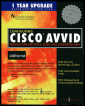
Introduces Cisco s converged media services technology, and the hardware and software required to make it work.
 TABLE OF CONTENTS
 Today s networks are coping with ever-increasing traffic and applications that require more bandwidth and faster response times. As we start connecting these networks together and allow remote users to dial in and access them, it is unlikely that will will have unlimited bandwidth available, due to cost constraints. It is the network designer s job to ensure that the applications running across these links can maintain a satisfactory level of performance and responsiveness, as well as make efficient use of the available bandwidth.
To improve responsiveness in congested networks, Cisco has provided congestion management and avoidance techniques. Congestion management, or queuing features, include first-in, first-out queuing (FIFO), priority queuing (PQ), custom queuing (CQ), and weighted fair queuing (WFQ). IOS version 12.x also introduces a new class-based weighted fair queuing feature (CBWFQ), Versatile Interface Processor (VIP), and distributed weighted fair queuing (DWFQ) for the Cisco 7000 series products.
In addition, Cisco empowers network architects with congestion avoidance techniques. These mechanisms monitor the traffic load in an attempt to anticipate and avoid bottlenecks before they occur. This is accomplished using random early detection (RED) algorithms.
Using compression is an effective way to make more efficient use of bandwidth by reducing the amount of data that needs to be transmitted between endpoints. Cisco provides a number of different compression techniques and options, which will be covered in this appendix.
Managing congestion over wide area network (WAN) links is important due to the mismatch in speed between input ports (10 Mbps Ethernet)...