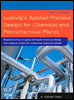
Ludwig's Applied Process Design for Chemical and Petrochemical Plants, Volume 1, Fourth Edition
Recently, mergers and downsizing in the various chemical process industries (CPIs) have required management to make effective decisions regarding investments in strategic assets, sometimes with limited engineering participation. Due to limited capital budgets, potential projects are scrutinized stringently before funds are allocated to proceed with them; management requires reasonably accurate cost estimates at each stage of the funding. The choice as to which estimation method to use at each stage depends on the information available at the time of preparation, its desired accuracy, and the end use of the estimate.
Many industries use some form of classification system to identify the various types of estimate that may be prepared during the life cycle of a project, and also to indicate the overall maturity and quality of the estimates produced. However, the process industries in general and individual companies and organizations have not been consistent and tend not to have a firm understanding of the terminology used during classification. The Association for Advancement of Cost Engineering International (AACE) recently developed recommended practices for cost estimate classification for the process industries [1]. Table 2-1 shows a list of recommended practices, which are intended to be the principal products and services requiring AACE certification.
| Documents | Recommended Practices |
|---|---|
| Cost Engineering Terminology | 10S-90 |
| Required Skills and Knowledge of a Cost Engineer | 11R-88 |
| Model Master's Degree Program with Emphasis in Cost Engineering | 12R-89 |
| Recommended Method for Determining Building Area | 13S-90 |
| Roles and Duties of a Planning... |