Ludwig's Applied Process Design for Chemical and Petrochemical Plants, Volume 1, Fourth Edition
There are many design features and styles of safety relief valves, such as flanged ends, screwed ends, valves fitted internally for corrosive service, high temperature service, cryogenic service/low temperatures, with bonnet or without, nozzle entrance or orifice entrance, and resistance to discharge piping strains on body. Yet most of these variations have little, if anything to do with the actual performance to relieve overpressure in a system/vessel.
A few designs are important to the system arrangement and relief performance. They are as follows.
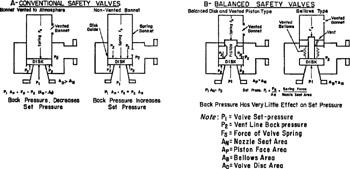
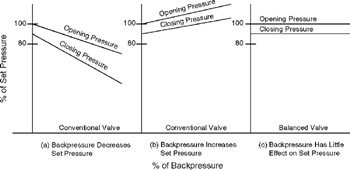
This valve design has the spring housing vented to the discharge side of the valve. The performance of the valve upon relieving overpressures is directly affected by any changes in the back pressure on the valve (opening pressure, closing pressure, and relieving capacity referenced to opening pressure) (see Figures 9-3, 9-6a, and 9-6b) [11]. When connected to a multiple relief valve manifold, the performance of the valve can be somewhat unpredictable from a relieving capacity standpoint due to the varying back pressure in the system.
This valve provides an internal design...