Ludwig's Applied Process Design for Chemical and Petrochemical Plants, Volume 1, Fourth Edition
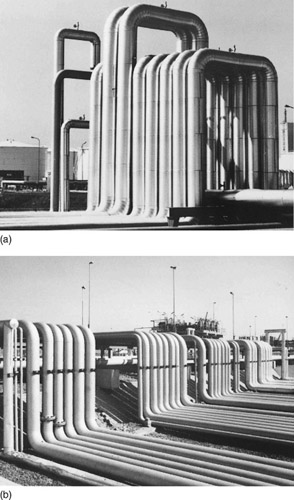
Transportation of fluids is important in the design of chemical process plants. In the chemical process industries (CPI), pipework and its accessories such as fitting make up 20-30% of the total design costs and 10-20% of the total plant investment. Maintenance requirements and energy usage in the form of pressure drop ( ?P) in the fluids being pumped add to the cost. Also, these items escalate each year in line with inflation. As a result, sound pipe-sizing practices can have a substantial influence on overall plant economics. It is the designer's responsibility to optimize the pressure drops in piping and equipment and to assess the most economic conditions of operations. Figure 4-1 illustrates piping layouts in a chemical plant.
The characteristics and complexity of flow pattern are such that most flows are described by a set of empirical or semi-empirical equations. These relate the pressure drop in the flow system as a function of flow rate, pipe geometry, and physical properties of the fluids. The aim in the design of fluid flow is to choose a line size and piping arrangement that achieve minimum capital and pumping costs. In addition, constraints on pressure drop and maximum allowable velocity in the process pipe should be maintained. These objectives require many trial-and-error computations which are well suited with the aid of a computer.