Ludwig's Applied Process Design for Chemical and Petrochemical Plants, Volume 1, Fourth Edition
Engineers, technologists, and scientists frequently collect paired data in order to understand the behavior of the system. Numerical methods of analysis have been employed to solve a wide range of steady and transient state problems. The fundamentals are essential in the basic operations of curve fitting, approximation, interpolation, numerical solutions of simultaneous linear and non-linear equations, numerical differentiation, and integration. These requirements are greater when new processes are designed.
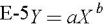
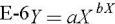
Various types of software packages are now readily available for scientists and engineers. They must fit a function or functions to measure data that fluctuate, which result from random error of measurement. A Fortran computer program (PROG1) was developed which determines the coefficients that provide the best fit for the following equations:
The non-linear Eqs. (E-5), (E-6), and (E-8) can be transformed by linearizing as follows:
Regression analysis uses statistical and mathematical methods to analyze experimental data and to fit mathematical models to these data. The least squares provide the best method for objectively determining the best straight line through a series of points. The method assumes that all deviations from the line are the result of error in the measurement of the dependent variable. The method of least squares yields the parameters which minimize the sum of squares of the residuals (e.g., the deviation of each measurement of the dependent variable from its calculated value). If ? is the calculated value and Y is the original value of the dependent...