Ludwig's Applied Process Design for Chemical and Petrochemical Plants, Volume 1, Fourth Edition
This appendix shows the various numerical techniques that can be employed in solving design problems, which could pose difficult if an analytical method is used. The numerical methods can readily be incorporated into computer programs to obtain results of design problems.
Simpson's rule is a numerical integration technique that is widely used in calculating the area under the curve. It is simple and has a greater degree of accuracy than the trapezoidal rule. The Simpson's 1/3 rule is based on quadratic polynomial interpolation.
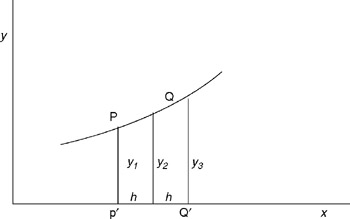
Figure H-1 shows a section of a curve and three coordinates erected to it at equally spaced intervals along the x-axis. Simpson's rule states that the area P ?PQQ ? is given approximately by the formula
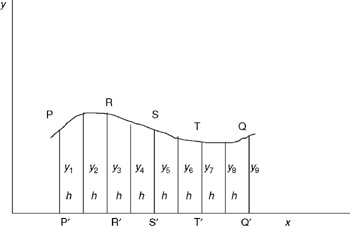
If we reduce the step size h, the result becomes more accurate. The interval over which the integral is to be taken is divided into larger number of equal sub intervals as shown in Figure H-2.
We will divide the total area into four sections, namely P ?PRR ?, R ?RSS ?, S ?STT ?, and T ?TQQ ?.
We shall write down the expression for each area and sum them up to obtain the total area P ?PQQ ?.
The total area is the sum of the areas P ?PRR ?, R ?RSS ?, S ?STT ?, and T