Practical Hydraulic Systems: Operation and Troubleshooting for Engineers and Technicians

Chapter 2: Pressure and Flow

2.1 Objectives

On reading this chapter, the student will be able to:

  • Explain and understand the various terms and definitions used in hydraulics

  • Understand the significance of Pascal's law and its applications

  • Understand the importance of flow and pressure in hydraulics.

2.2 Pressure

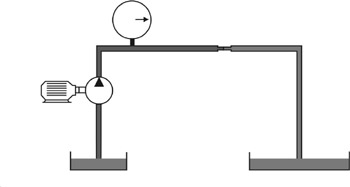
Pressure along with flow is one of the key parameters involved in the study of hydraulics. Pressure in a hydraulic system comes from resistance to flow. This can be best understood from Figure 2.1.


Figure 2.1: Pressure buildup in a hydraulic system

Consider the flow from a hydraulic pump as shown. Here the pump produces only flow and not pressure. However any restriction in the flow from the pump results in the formation of pressure. This restriction or resistance to flow normally results from the load induced in the actuator. The various conductors and components of the hydraulic system such as pipes and elbows also act as points of resistance and contribute to the generation of pressure in the system.

Pressure ( P) is defined as the force ( F) acting normally per unit area ( A) of the surface and is given by the equation:


Pressure in the SI unit is measured in terms of N/m 2 also known as a Pascal. Pressure can also be expressed in terms of bar, where


Pressure in the US unit is measured in terms of lb/in. 2 or psi, where


2.2.1 Pressure in fluids

Fluids are composed of molecules, which are in continuous random...

UNLIMITED FREE
ACCESS
TO THE WORLD'S BEST IDEAS

SUBMIT
Already a GlobalSpec user? Log in.

This is embarrasing...

An error occurred while processing the form. Please try again in a few minutes.

Customize Your GlobalSpec Experience

Category: Hydraulic Filters
Finish!
Privacy Policy

This is embarrasing...

An error occurred while processing the form. Please try again in a few minutes.