Practical Hydraulic Systems: Operation and Troubleshooting for Engineers and Technicians

7.8: Steel tubing

7.8 Steel tubing

Steel tubing is used in hydraulic systems when rigid lines are required. They are easier to assemble and don't require welding in order to achieve leak-proof connections. Seamless steel tubing is the most widely used conductor type for hydraulic systems as it has significant advantages over pipes. The tubing can be bent into any shape thereby reducing the number of fittings in a system. Tubing is easier to handle and can be reused without any sealing problems. For low-volume systems, tubing can handle the pressure and flow requirements with less bulk and weight. However the flip side to tubing and their fittings is that that they are very expensive.

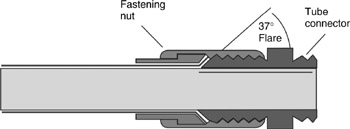
Steel tubes are measured and specified by their outside diameter and wall thickness. The tubing grade and wall specification determine the pressure ratings. As shown in Figure 7.32, one piece of tubing is connected to another component through a tube connector and fastening nut. The tube is often pre-flared to an angle of 37 to accept a 37 flare connector as shown in Figure 7.32.


Figure 7.32: Steel tubing arrangement

Some of the most common tube sizes used in hydraulic systems have been tabulated below.

Tube OD inches

Wall Thickness in mm

Wall Thickness in mm

Tube ID in mm

Tube OD

Tube ID in mm

1/8

0.89

1.5

5/8

0.89

14.0

3/16

0.89

3.0

3/4

1.3

16.5

1/4

0.89

4.5

7/8

1.3

19.8

5/16

0.89

6.2

1

1.65

22.9

3/8

0.89

7.8

1 1/4

1.65

28.5

1/2

0.89

UNLIMITED FREE
ACCESS
TO THE WORLD'S BEST IDEAS

SUBMIT
Already a GlobalSpec user? Log in.

This is embarrasing...

An error occurred while processing the form. Please try again in a few minutes.

Customize Your GlobalSpec Experience

Category: Tubing
Finish!
Privacy Policy

This is embarrasing...

An error occurred while processing the form. Please try again in a few minutes.