Practical Hydraulic Systems: Operation and Troubleshooting for Engineers and Technicians

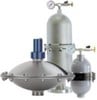
Accumulators are devices, which simply store energy in the form of fluid under pressure. This energy is in the form of potential energy of an incompressible fluid, held under pressure by an external source against some dynamic force. This dynamic force can come from three different sources: gravity, mechanical springs or compressed gases. The stored potential energy in the accumulator is the quick secondary source of fluid power capable of doing work as required by the system. This ability of the accumulators to store excess energy and release it when required, makes them useful tools for improving hydraulic efficiency, whenever needed. To understand this better, let us consider the following example.
A system operates intermittently at a pressure ranging between 150 bar (2175 psi) and 200 bar (2900 psi), and needing a flow rate of 100 lpm for 10 s at a frequency of one every minute. With a simple system consisting of a pump, pressure regulator and loading valves, this requires a 200 bar (2900 psi), 100-lpm pump driven by a 50 hp (37 kW) motor, which spends around 85% of its time, unloading to the tank. When an accumulator is installed in the system as shown in Figure 7.12, it can store and release a quantity of fluid at the required system pressure.
The operation of the system with accumulator is illustrated by Figure 7.13;
At time A, the system is turned...