Practical Hydraulic Systems: Operation and Troubleshooting for Engineers and Technicians

7.9: Flexible hoses

7.9 Flexible hoses

Flexible hoses are one of the most important conductors used in hydraulic systems. They are used in applications where lines must flex or bend or in other words when hydraulic components such as actuators are subjected to movement. Hoses are fabricated in layers of elastomer (synthetic rubber) and braided fabric or braided wire, which permit operation at high pressure.

Normally, hoses are rated by a safety factor between 1and 4. The various types of coatings and reinforcements used, determine the specific pressure ratings. The volume and velocity of the fluid flow determines the hose size and unlike pipes and tubings, hoses are designated by the inside diameter.

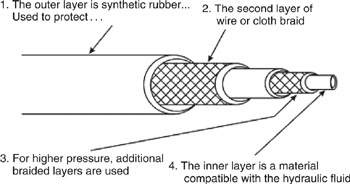
The construction of a typical flexible hose is illustrated in Figure 7.35.


Figure 7.35: Construction of a flexible hose

The outer layer is normally made of synthetic rubber and serves to protect the braid layer. The hose can have as few as three layers (one being the braid). When multiple layers are used, they may alternate with synthetic rubber layers or the wire layers may be directly placed over one another. Hose construction has been standardized by the Society of Automotive Engineers under SAE J5 17 also known as the R series (an example being 100 R4) by which the cover, construction, application and pressure rating is described.

The table below gives typical hose sizes and dimensions for a single wire braided and double wire braided designs.

Hose Size

Tube OD inches

Single Wire Braided

Double Wire Braided

Hose ID inches

UNLIMITED FREE
ACCESS
TO THE WORLD'S BEST IDEAS

SUBMIT
Already a GlobalSpec user? Log in.

This is embarrasing...

An error occurred while processing the form. Please try again in a few minutes.

Customize Your GlobalSpec Experience

Category: Industrial Hose
Finish!
Privacy Policy

This is embarrasing...

An error occurred while processing the form. Please try again in a few minutes.