Rules of Thumb for Chemical Engineers: A Manual of Quick, Accurate Solutions to Everyday Process Engineering Problems, Fourth Edition

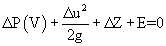
Two of the most useful and basic equations are
| (1) | |
| (2) | |
where
| ?h | = Head loss in feet of flowing fluid |
| u | = Velocity in ft/sec |
| g | = 32.2 ft/sec 2 |
| P | = Pressure in lb/ft 2 |
| V | = Specific volume in ft 3/lb |
| Z | = Elevation in feet |
| E | = Head loss due to friction in feet of flowing fluid |
In Equation 1 ?h is called the "velocity head." This expression has a wide range of utility not appreciated by many. It is used "as is" for
Sizing the holes in a sparger
Calculating leakage through a small hole
Sizing a restriction orifice
Calculating the flow with a pilot tube
With a coefficient it is used for
Orifice calculations
Relating fitting losses, etc.
For a sparger consisting of a large pipe having small holes drilled along its length Equation 1 applies directly. This is because the hole diameter and the length of fluid travel passing through the hole are similar dimensions. An orifice, on the other hand, needs a coefficient in Equation 1 because hole diameter is a much larger dimension than length of travel (say 1/8 in for many orifices). Orifices will be discussed under "Metering" in this chapter.
For the situations covered here, compressible fluids might reach sonic velocity. When this happens, further decreases in downstream pressure do not produce additional flow. Sonic velocity occurs at an upstream to downstream absolute pressure ratio of about 2:1.