Rules of Thumb for Chemical Engineers: A Manual of Quick, Accurate Solutions to Everyday Process Engineering Problems, Fourth Edition
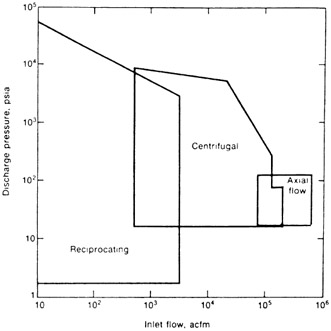
The following graph from the Compressor Handbook is a good quick guide for comparing ranges of application for centrifugal, reciprocating, and axial flow compressors.
Dimoplon, William, "What Process Engineers Need to Know About Compressors," Compressor Handbook for the Hydrocarbon Industries, Gulf Publishing Co., 1979.
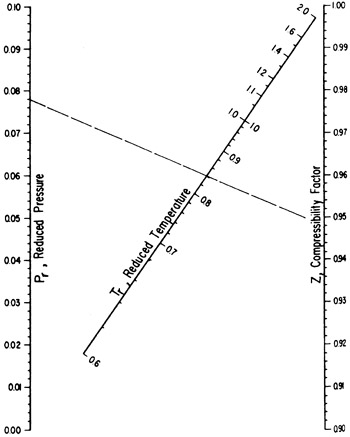
A quick estimate of the compressibility factor Z can be made from the nomograph1 ,2 shown as Figure 1.
where
| T | = Temperature in consistent absolute units |
| T c | = Critical temperature in consistent absolute units |
| T R | =T/T c |
| P | = Pressure in consistent absolute units |
| P c | = Critical pressure in consistent absolute units |
| P R | = P/P c |
An accuracy of one percent is claimed, but the following gases are excluded: helium, hydrogen, water, and ammonia.
1. McAllister, E. W., Pipe Line Rules of Thumb Handbook, 3rd Ed., Gulf Publishing Co., 1993.
2. Davis, D. S., Petroleum Refiner, 37, No. 11, 1961.
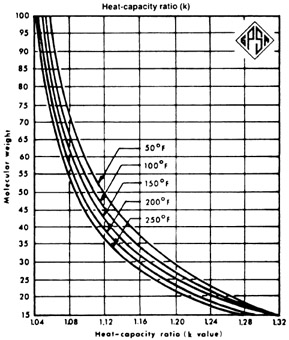
The following handy graph from the GPSA Engineering Data Book allows quick estimation of a gas's heat-capacity ratio (K = C p/C v) knowing only the gas's molecular weight.
where
| C p | = Heat capacity at constant pressure, Btu/lb F |
| C v |