Rules of Thumb for Chemical Engineers: A Manual of Quick, Accurate Solutions to Everyday Process Engineering Problems, Fourth Edition

Dynamic type pumps obey the affinity laws:
Capacity varies directly with impeller diameter and speed.
Head varies directly with the square of impeller diameter and speed.
Horsepower varies directly with the cube of impeller diameter and speed.
The handiest pump horsepower formula for a process engineer is:
where:
| HP | = Pump horsepower |
| GPM | = Gallons per minute |
| ?P | = Delivered pressure (discharge minus suction), psi |
| Eff | = Pump efficiency, fraction |
An equation was developed by the author from the pump efficiency curves in the eighth edition of The GPSA Engineering Data Book,1 provided by the M. W. Kellogg Co. The curves were found to check vendor data well. The equation admittedly appears bulky, but is easy to use.
where
| Eff. | = Pump percentage efficiency |
| F | = Developed head, ft |
| G | = Flow, GPM |
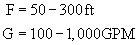
Ranges of applicability:
The equation gives results within about 7% of the aforementioned pump curves. This means within 7% of the curve valve, not 7% absolute, i.e., if the curve valve is 50%, the equation will be within the range 50 3.5%.
For flows in the range 25 99 GPM a rough efficiency can be obtained by using the equation for 100 GPM and then subtracting 0.35%/GPM times the difference between 100 GPM and the low flow GPM. For flows at the bottom of the range (25 30 GPM), this will give results within about 15% for the middle of the head range and 25% at the extremes. This is adequate for ballpark...