Sensor Technology Handbook

Young H.Lee and Raj Mutharasan, Department of Chemical Engineering, Drexel University
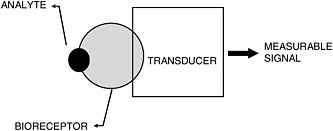
Biosensor=bioreceptor+transducer. A biosensor consists of two components: a bioreceptor and a transducer. The bioreceptor is a biomolecule that recognizes the target analyte, and the transducer converts the recognition event into a measurable signal. The uniqueness of a biosensor is that the two components are integrated into one single sensor (Figure 6.1.1). This combination enables one to measure the target analyte without using reagents (Davis et al, 1995). For example, the glucose concentration in a blood sample can be measured directly by a biosensor made specifically for glucose measurement, by simply dipping the sensor in the sample. This is in contrast to the commonly performed assays, in which many sample preparation steps are necessary and each step may require a reagent to treat the sample. The simplicity and the speed of measurements that require no specialized laboratory skills are the main advantages of a biosensor.
Enzyme is a Bioreceptor. When we eat food such as hamburgers and french fries, it is broken down into small molecules in our body via many reaction steps (these breakdown reactions are called catabolism). These small molecules are then used to make the building blocks of our body, such as proteins (these synthesis reactions are called anabolism). Each of these catabolism and anabolism reactions (the combination is called metabolism) are catalyzed by a specific enzyme. Therefore, an enzyme