Total Performance Scorecard: Redefining Management to Achieve Performance with Integrity
To improve is to change; to be perfect is to change often.
Sir Winston Churchill
There is only one valid definition of a business purpose: to create a satisfied customer. It is the customer who determines what the business is.
Peter F. Drucker
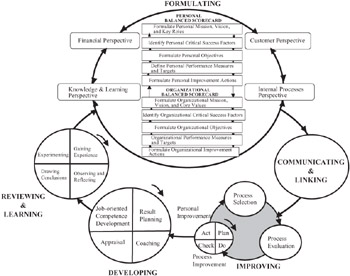
This chapter emphasizes the systematic execution of the formulated organizational and personal improvement actions. Figure 5.1 illustrates this third phase in the TPS cycle. The improvement of your behavior and the organization's business processes is central here, and is based on PDCA learning (see Figure 2.5): how to correct mistakes, improve what already exists, and to do things right the first time. When you are working on personal improvement this involves behavioral, communicative, and management skills; health; assertiveness; financial stability; personal value-added factors; and other issues. The organizational improvement actions relate to:
Improving; this entails doing existing things better. Efficiency or doing things right is the pivotal issue here.
Renewing; this deals with doing existing things differently. Here we deal with effectiveness or doing the right things.
Therefore, improving and renewing belong together. The interrelated improvement process, which is aimed at business processes, can also be broken down into the following three steps (Rampersad, 2001A):
Process Selection; this is selecting and defining the critical business processes related to the improvement actions eligible for continuous improvement.
Process Evaluation; this entails the description, evaluation, and documentation of the selected processes.
Process Improvement;