Wood Pole Overhead Lines
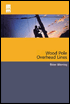
Concentrating on the mechanical aspects of distribution wood pole lines, this informative text includes coverage of live line working, environmental influences, climate change and international standards.
 TABLE OF CONTENTS
 In order to obtain the desired conductivity and strength the first port of call is the material to be used. This may not be suitable for all our requirements (e.g. the best material for strength and conductivity may corrode too quickly) but heat treatment could help the situation.
The most common materials used for OHL conductors are:
copper hard drawn (HD)
cadmium copper alloy
aluminium
aluminium magnesium silicon alloy
galvanised steel
aluminium clad steel.
Cadmium copper is now banned from use for new lines in Europe, but it is included for completeness as there are many existing lines using this material.
The conductor characteristics are summarised in Table 8.3.
| Parameter | Units | Hard drawn copper | Cadmium copper | Hard drawn aluminium | Aluminium alloy | Galvanised steel | Aluminium clad steel |
|---|---|---|---|---|---|---|---|
| Conductivity | % IACS [1] | 97 | 79 | 61 | 53 | 9 | 20 |
| Resistance | ?mm 2/km | 17.7 | 21.8 | 28.3 | 32.5 | 192 | 84.8 |
| Temp coeff. | per C | 0.0038 | 0.0031 | 0.0040 | 0.0036 | 0.0054 | 0.0051 |
| of resistance | |||||||
| Coeff. of linear | 10 -6per C | 17 | 17 | 23 | 23 | 11.5 | 13 |
| expansion | |||||||
| Linear mass | kg/mm 2km | 8.89 | 8.945 | 2.7 | 2.7 | 7.8 | 6.59 |
| Ultimate | N/mm 2 | 414 | 621 | 160 200 | 295 | 1320 1700 | 1100 1344 |
| tensile | |||||||
| stress (UTS) | |||||||
| Modulus of | Gpa | 125 | 125 | 70 | 70 | 200 | 162 |
| elasticity | |||||||
| [1] |