Wood Pole Overhead Lines
Concentrating on the mechanical aspects of distribution wood pole lines, this informative text includes coverage of live line working, environmental influences, climate change and international standards.
 TABLE OF CONTENTS
 This section is essentially for background information. Engineers may at times need to be satisfied that a particular manufacturer has high-quality production techniques, and so may feel justified in seeing how a company makes its conductor. Is the process clean, efficient, reliable? what are the quality control standards etc.? In order to grasp what is happening, the basics of conductor manufacturing can therefore be a useful starting point.
Basically, the manufacturing process consists of drawing the metal down from the delivered rod size to the required wire size and then stranding it to form the conductor. This is fine for most basic materials. However, the processing of aluminium alloy is more complex and offers the manufacturer a further tool in his armoury of manufacturing specific characteristics.
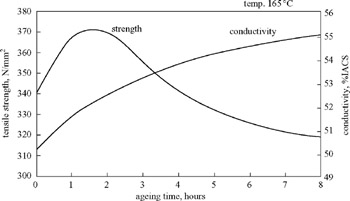
For an AAAC, the initial rod is manufactured from various alloying elements such as magnesium, silicon, iron and copper dissolved into the base aluminium. As the material is an alloy and not a compound, the various elements will diffuse out with time and temperature, thereby changing the characteristics of the material. To avoid this, the rod is drawn down (which work-hardens the material) and then heat treated to allow the alloying elements to change the characteristics until the required values are achieved. On a simple basis, the strength and conductivity will vary according to the temperature and time of heat treatment according to the graph in Figure 8.3.
Stranding sounds easy but...