Wood Pole Overhead Lines
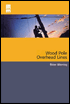
Concentrating on the mechanical aspects of distribution wood pole lines, this informative text includes coverage of live line working, environmental influences, climate change and international standards.
 TABLE OF CONTENTS
 This section will deal with the key electrical design considerations necessary to select the appropriate conductor for a given application. These are the continuous and short-time current rating, inductive and capacitative reactance and voltage drop, which are only some of the factors that are required. Other considerations to be taken into account may include cost, mechanical suitability, standardisation for stock and maintenance simplification etc.
Current rating is of primary importance. The conductor, when carrying current, will lose energy through resistive losses and gain energy from solar gain. There will be counterbalancing radiative and convective losses from the conductor surface. High conductor temperatures can be used to increase current carrying capacity but this can lead to loss of strength, increased sag and increased oxidation (corrosion).
DC resistance is dependent only on the conductor temperature. The various standards specify strand resistance and the conductor resistance is calculated from that.
AC resistance is dependent on the skin effect and is therefore dependent on current frequency and the material used. On steel-cored conductors it is also dependent on the magnetic properties of the core.
Inductive and capacitive reactances are present in AC lines. They are dependent on conductor diameter, phase spacing, line height and length, frequency and current levels. Reactance is therefore a function of the total line design.
High voltage levels on a conductor will cause local ionisation of the air and cause energy loss, noise (audible...