Advanced Mathematics For Engineering and Science
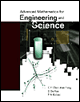
As the product of a close collaboration between two mathematicians and an engineer, this pragmatic text provides the know-how and know-why to understanding mathematics and its many applications.
 TABLE OF CONTENTS
 The inadequacy of the real number system (rational and irrational numbers) in solving algebraic equations was known to mathematicians in the past. It therefore became necessary to extend the real number system, so as to obtain meaningful solutions to simple equations such as
| (3.1 1) |  |
For quite sometime, it appears that equations, which could not be solved in the domain of real numbers, were solved by accepting  as a possible number. This notation, however, has had its own shortcomings. Euler was the first to introduce the symbol i for with the basic property
| (3.1 2) |  |
(Electrical engineers use j to denote .)
He also established the relationships between complex numbers and trigonometric functions. However, in those times, no actual meaning could be assigned to the expression . It was, therefore, called an imaginary (as opposed to real) number. This usage still prevails in the literature.
It was not until around 1800 that sound footing was given to the complex number system by Gauss, Wessel, and Argand. Gauss proved that every algebraic equation with real coefficients has complex roots of the form c+id. Real roots are special cases, when d is zero. Argand proposed a graphical representation of complex numbers. The concept of a function was subsequently extended to complex functions of the type
| (3.1 3) |  |
where z (=x+iy) is the independent variable.
The concept of complex variables is a powerful and a widely used tool in mathematical analysis. The theory of differential equations has been...