Advanced Mathematics For Engineering and Science
As the product of a close collaboration between two mathematicians and an engineer, this pragmatic text provides the know-how and know-why to understanding mathematics and its many applications.
 TABLE OF CONTENTS
 In the first two chapters, we have considered ordinary differential equations (O.D.E.). An O.D.E. is one in which there is only one independent variable and all derivatives are ordinary derivatives. A partial differential equation (P.D.E.) is one in which there are two or more independent variables and the derivatives that occur in it are partial derivatives.
Most processes that are of interest to engineers and scientists take place in a two or three-dimensional space. Frequently, time may also be involved. The number of independent variables is usually more than one and the equations governing these processes are partial differential equations.
In Chapter 3, we have seen that to determine the velocity field of an incompressible and irrotational flow, we have to solve Laplace s equation, which is a partial differential equation. The equation describing the vibrations of a string can be written as
| (5.1 1) | 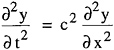 |
where y is the displacement of the string from its equilibrium position, t is the time, x is the coordinate of a point on the string, and c is a constant. The diffusion of a material in a homogeneous medium is governed by the equation
| (5.1 2) | 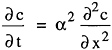 |
where ? is a constant, c is the concentration, t and x are time and position as in Equation (5.1 1). In Chapter 10, we shall see that, in mechanics, Hamilton s equations of motion are given by a set of partial differential equations. Other examples of P.D.E. and their solutions will be given in this and the...