Advanced Mathematics For Engineering and Science

As the product of a close collaboration between two mathematicians and an engineer, this pragmatic text provides the know-how and know-why to understanding mathematics and its many applications.
 TABLE OF CONTENTS
 We now apply the discussion of the previous section to the special case where f(x) is a polynomial of degree n. We want to find the roots (real or complex) of the polynomial equation
| (7.3 1a,b) |  |
where a n ?0, n>0.
We note the following facts regarding Equations (7.3 1a,b) with real or complex coefficients.
There are n (not necessarily distinct) real or complex roots.
If n is odd and all coefficients are real, there is at least one real root.
If all the coefficients are real and complex roots exist, they occur as conjugate pairs.
If x 0 is a root of Equation (7.3 1a,b), then necessarily
| (7.3 2) |  |
where g(x) is a polynomial of degree (n ?1).
To use Newton s method for computing the root of an equation [Equation (7.2 11)], we need to evaluate f(x k) and f'(x k). We describe a method, known as Horner s method, for calculating f(x k) and f ?(x k) where f is a polynomial. Recall that for any polynomial as given in Equations (7.3 1a,b) we can write
| (7.3 3) |  |
where
| (7.3 4) |  |
and R is a constant. Equations (7.3 1a,b, 3, 4) are compatible provided
| (7.3 5a) |  |
| (7.3 5b) | 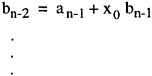 |
| (7.3 5c) |  |
| (7.3 5d) |  |
Thus if (x ?x 0) is not a factor of f(x), we have from Equation (7.3 3)
| (7.3 6a,b) |  |
In Equations (7.3 5a to d), the b i are given in terms of a n and x 0. Therefore, starting from Equation (7.3 5a), we...