Advanced Mathematics For Engineering and Science

As the product of a close collaboration between two mathematicians and an engineer, this pragmatic text provides the know-how and know-why to understanding mathematics and its many applications.
 TABLE OF CONTENTS
 Calculus of variations was introduced by Johann Bernouilli two centuries ago and is now widely used in optimization, control theory, and for computing approximate solutions of differential equations. In differential calculus we learned to determine the extreme values (maxima or minima) of a function. For example, the function f(x)=x 2 has a minimum at x=0, where its value is 0, f(x) is greater than zero everywhere else.
Calculus of variations is an extension of the above concept. Suppose we wish to determine the shortest plane curve joining two points A and B in the xy-plane as shown in Figure 9.1 1. If the coordinates of A and B are (a, y (a)) and (b, y (b)) respectively, then the length s of the curve y=y(x) joining A and B is given by
| (9.1 1) | 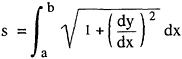 |
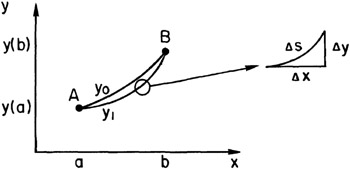
For each curve y(x), we can obtain the corresponding value of s and we have to determine the curve y(x) which yields the minimum value of s. Figure 9.1 1 shows two such curves, y 0 and y 1. In variational calculus we need to determine a function, if it exists, such that an integral is an extremum. That is to say, we wish to find the extreme values of a functional, where a functional can loosely be defined as a rule which assigns a real number to a function. In this example, we assign a number s to each function y(x) and the...