Chaos In Circuits And Systems
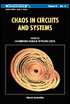
With a combination of overview, tutorial and technical articles, this book describes state-of-the-art research on significant problems in the field of chaos in circuits and systems.
 TABLE OF CONTENTS
 This article reviews various types of intermittent chaos occurring in phase-locked loop systems. First, we will demonstrate a local in-termittency due to a saddle-node bifurcation, which was discovered and named as Type I intermittency by Pomeau and Manneville. Second, we will demonstrate a global intermittency called "Crisis-Induced Intermittency", caused by a tangency of the stable and the unstable manifolds of two saddle points. Third, we will demonstrate an intermittency observed in comparatively high-dimensional systems; on-off intermittency and a new type of intermittency, which has been discovered by us.
For a long time, phase-locked loops (PLL's) have been utilized in many electronic systems; for example, weak signal receivers from satellites under low signal-to-noise environment, pulse-wave synchronization in TV sets and radar systems, and frequency synthesis and conversion in quarts crystal oscillators. PLL devices are so useful that they have been manufactured as a one-chip integrated circuit (for example 4046). The traditional PLL design mostly employs linear theory, because the PLL designer is interested firstly in time-response for a small input frequency (or phase) change in the phase-locked condition. The PLL dynamics, when out-of-lock, however, is essentially nonlinear with periodic nonlinearity similar to the swing equation of a pendulum. In particular, if a phase- or...