Chaos In Circuits And Systems
With a combination of overview, tutorial and technical articles, this book describes state-of-the-art research on significant problems in the field of chaos in circuits and systems.
 TABLE OF CONTENTS
 In this chapter, we show that using the phase-lock principle is a very fruitful way for advancing in self-excitation and controlling chaotic oscillations, which are important for novel applications, particularly for communication.
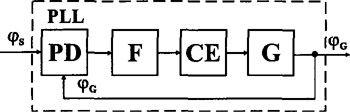
We consider a standard automatic loop for controlling generator frequency, as shown in Fig. 6.1. It is a well-known phase-locked loop (PLL) [1]. Oscillations at the output of the controlled generator G, which has current phase ? G, and oscillations of the reference generator, which has current phase ? S, act on the multiplier (phase detector) PD to produce the output voltage of PD that depends on phase difference ? = ? S ? ? G. This is supposed to be a sinusoidal function for definiteness in this chapter. After being filtered by the loop filter F, with transfer function K( p), the resulting signal arrives at the input of the control element CE that directly changes the output frequency and phase of G, causing them to coincide with the frequency and phase of the signal from the reference generator. The mathematical model of such a system is generally written in the form [1] , [2]

Here, p ? d/ dt, ? is the maximal deviation of generator frequency that can balance the control loop,