Chaos In Circuits And Systems
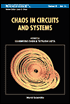
With a combination of overview, tutorial and technical articles, this book describes state-of-the-art research on significant problems in the field of chaos in circuits and systems.
 TABLE OF CONTENTS
 In a digital communications system, data is transmitted from one location to another by mapping bit sequences to symbols, and symbols to sample functions of analog waveforms. The analog waveforms pass through a band-limited (possibly time-varying) analog channel, where these signals are distorted and noise is added. The analog sample functions sent through the channel are weighted sums of basis functions. In a typical conventional system, the basis functions are sinusoids; in a chaotic communications system, the sample functions are segments of chaotic waveforms.
At the receiver, the symbols may be recovered by means of coherent detection, where all possible sample functions are known, or by noncoherent detection, where one or more characteristics of the transmitted sample functions are determined by the demodulator. In a coherent receiver, synchronization is the most commonly used technique for recovering the sample functions from the received waveform. These sample functions are then used as reference signals for a correlator.
Synchronization-based coherent receivers have advantages over noncoherent receivers in terms of bandwidth efficiency (in narrow-band systems), data rate (in chaotic systems), and noise performance (in both).
These advantages are lost if carrier synchronization cannot be maintained, for example, under poor propagation conditions. Under these circumstances, communication without synchronization may be preferable.
This chapter shows in a tutorial manner how the theory of...