Chaos In Circuits And Systems
With a combination of overview, tutorial and technical articles, this book describes state-of-the-art research on significant problems in the field of chaos in circuits and systems.
 TABLE OF CONTENTS
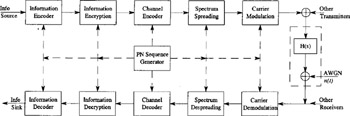
 This chapter is devoted to a study of secure chaotic communication, particularly for digital chaotic spreading spectrum communication systems. A schematic of an existing spreading spectrum communication system (SSCS) is shown in Fig. 26.1. In this system, the spreading/dispreading module may work in either DS (direct sequence) or FH (frequency hopping) mode. Our study on chaotic SSCS (CSSCS) is in a broad sense: whenever a chaotic PN (pseudonoise) sequence (shown by the dotted line in Fig. 26.1) plays a role in any SSCS module (shown by the solid line in Fig. 26.1), it is referred to as a CSSCS.
It is of great interest to address the issue of why the study of chaotic communication systems has become one spotlight in the communication community during the last decade. In the 1980's, chaotic dynamics in physics evolved into electronic engineering, thereby forming a chaotic electronics discipline, in which the invention of the chaotic Chua's circuit is regarded as a pioneer contribution [1]. By the end of the 1980's, we already suggested to replace the m-sequence, widely used in electronic engineering, by the chaotic sequence generated by the Logistic Map for the latter has better statistic characteristics [2]. This recommended application soon became feasible as witnessed by the report on...