Chaos In Circuits And Systems
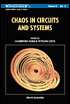
With a combination of overview, tutorial and technical articles, this book describes state-of-the-art research on significant problems in the field of chaos in circuits and systems.
 TABLE OF CONTENTS
 In the study of nonlinear phenomena in electronics, experiments are indispensable for the purpose of verifying the analytical findings and simulation results. This chapter begins with a discussion on the roles of experimental measurements and computer simulations in the study of nonlinear systems. A tutorial overview of the commonly used laboratory techniques for studying nonlinear phenomena in electronic circuits is given. Specifically, some techniques for displaying phase portraits, Poincar sections and bifurcation diagrams on the oscilloscope are discussed.
Sensitive dependence on initial conditions and lack of long-term predictability are key features of chaotic systems, which have profound implications on the approaches taken to study such systems. From the computational standpoint, exact trajectories cannot be sought for a chaotic system, no matter how accurate the numerical simulations and the models used in the simulations are. Any computed trajectory will "eventually be wrong". This is particularly true with modern digital computers which introduce round-off errors, and depending upon the algorithms used, the errors can accumulate and render any solution eventually inaccurate. This raises some doubts as to how much we can trust our model (for a particular system). In particular, we may ask several questions: How well does the model describe reality? And under what conditions? Is it a physical model...