Chaos In Circuits And Systems
With a combination of overview, tutorial and technical articles, this book describes state-of-the-art research on significant problems in the field of chaos in circuits and systems.
 TABLE OF CONTENTS
 In a typical conventional modulation scheme, sinusoidal basis functions are used and the bit duration T is an integer multiple of the period of the basis functions; hence, ? T 0 g 2 j dt = 1 and ? T 0 g j( t) dt = 0, i.e., the auto- and cross-correlation estimation problems do not appear.
A chaotic basis function g j( t) is different in every interval of length T. Consequently, ? T 0 g 2 j( t) dt is different for every symbol, even if the same symbol is transmitted repeatedly.
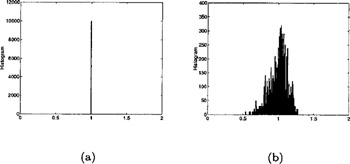
Figures 22.3(a) and 22.3(b) show histograms of samples of ? T 0 g 2 j( t) dt for periodic and chaotic waveforms g j( t), respectively. In the periodic case, all samples lie at ? T 0 g 2 j( t) dt = 1. By contrast, the samples in the chaotic case are centered at E[ ? T 0 g 2 j( t) dt] = 1, as before, but have non-zero variance.
As in the case of channel noise, this non-zero variance causes the components z mj of the observation vector to differ from the...